
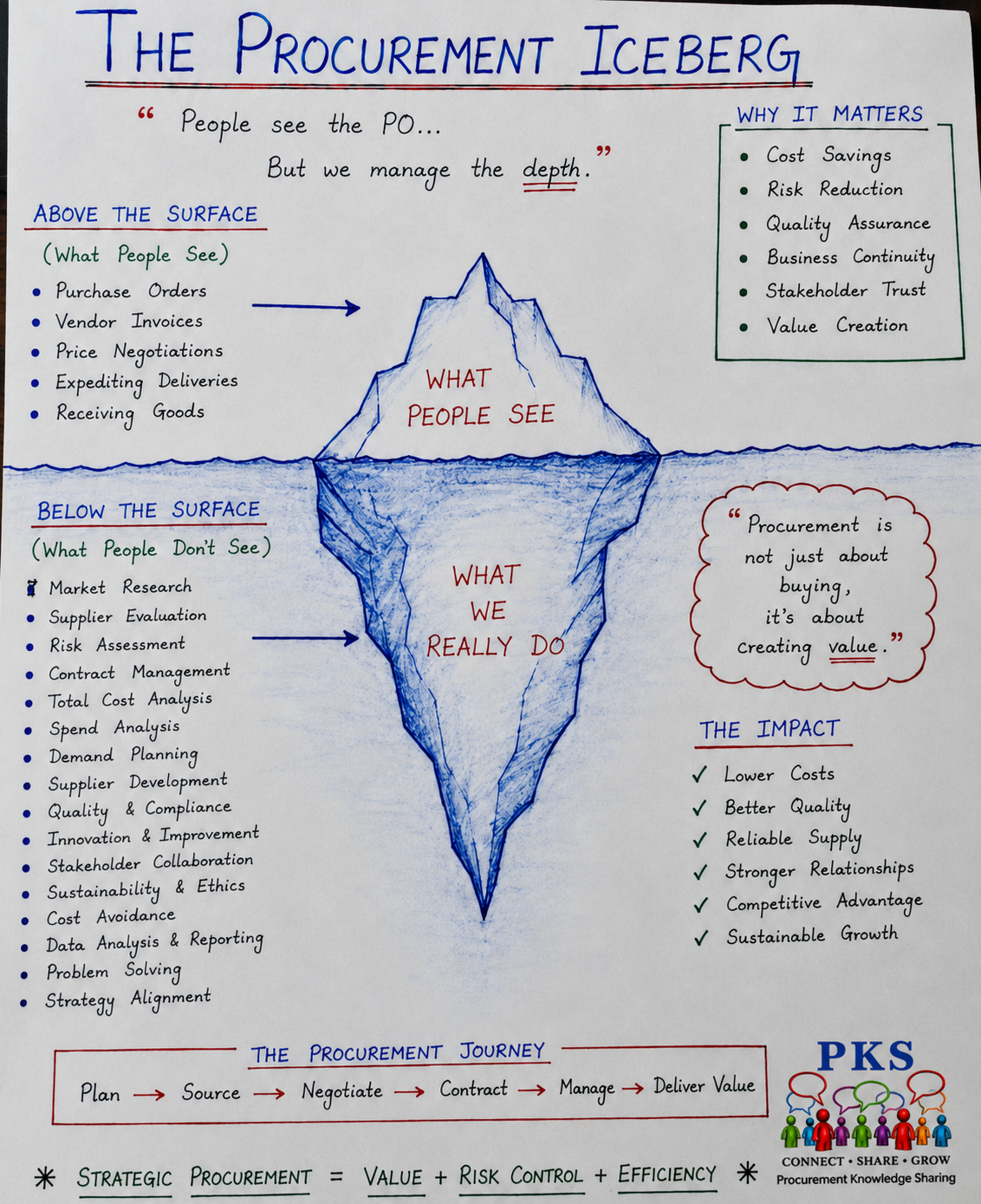
“People see the PO. But we manage the depth.”
A Purchase Order is visible.
A negotiated price is visible.
A supplier invoice is visible.
But what happens before, between, and after these visible activities is where procurement creates — or loses — real business value.
Think of procurement as an iceberg. The part above the water is easy to see. The much larger part beneath the surface is where the real work happens.
🔹 Above the Surface: What People See
Most stakeholders associate procurement with activities such as:
- 📄 Raising Purchase Orders
- 💰 Negotiating prices
- 🧾 Processing vendor invoices
- 🚚 Expediting deliveries
- 📦 Receiving goods
These are important, but they are only the visible output of a much larger process.
The danger is that when procurement is judged only by these activities, the function can look purely administrative.
🔹 Below the Surface: What Procurement Really Does
The real procurement effort often starts long before an RFQ is sent to a supplier.
It involves:
- 🔎 Market Research – understanding suppliers, pricing and market dynamics
- 🏭 Supplier Evaluation & Development – finding the right capabilities and building alternatives
- ⚠️ Risk Assessment – identifying supply, financial, quality and continuity risks
- 📑 Contract Management – protecting the organisation beyond the purchase price
- 📊 Spend & Total Cost Analysis – looking beyond the quoted price
- 📅 Demand Planning – aligning requirements with business needs
- ✅ Quality & Compliance – ensuring suppliers deliver what was actually promised
- 💡 Innovation & Improvement – challenging conventional ways of buying
- 🤝 Stakeholder Collaboration – balancing the needs of finance, operations, quality and business teams
- 🌱 Sustainability & Ethics – building responsible supply chains
- 🧠 Data Analysis & Problem Solving – converting information into better decisions
- 🎯 Strategy Alignment – connecting procurement decisions with business objectives
This is the part that often remains invisible.
🔹 Why Does the Depth Matter?
Because the lowest quoted price is not necessarily the lowest cost.
A supplier offering a cheaper price can still create:
- ❌ Quality failures
- ❌ Production disruptions
- ❌ Delayed deliveries
- ❌ Higher logistics costs
- ❌ Contractual disputes
- ❌ Dependency on a single source
- ❌ Reputation or compliance risks
Conversely, a well-developed procurement strategy can deliver:
- ✅ Sustainable cost savings
- ✅ Lower business risk
- ✅ Better quality
- ✅ Reliable supply
- ✅ Stronger supplier relationships
- ✅ Greater stakeholder confidence
- ✅ Competitive advantage
🔹 Procurement Is a Journey — Not a Transaction
Plan → Source → Negotiate → Contract → Manage → Deliver Value
The PO is only one point in this journey.
The real question is not:
“How much did procurement buy it for?”
It is:
“What value did procurement create for the business?”
That value may appear as cost avoided, risk prevented, downtime eliminated, working capital improved, quality protected, supplier capability developed, or business continuity secured.
🧊 The Real Procurement Iceberg
The next time someone looks at procurement and sees only a PO, remember:
They are seeing the tip.
Underneath it lies strategy, analysis, relationships, risk management, negotiation, market intelligence, problem-solving and countless decisions that may never appear on a purchase order.
Strategic Procurement = Value + Risk Control + Efficiency
And that is why procurement is not simply about buying things.
It is about making the business stronger through every decision behind the purchase.